
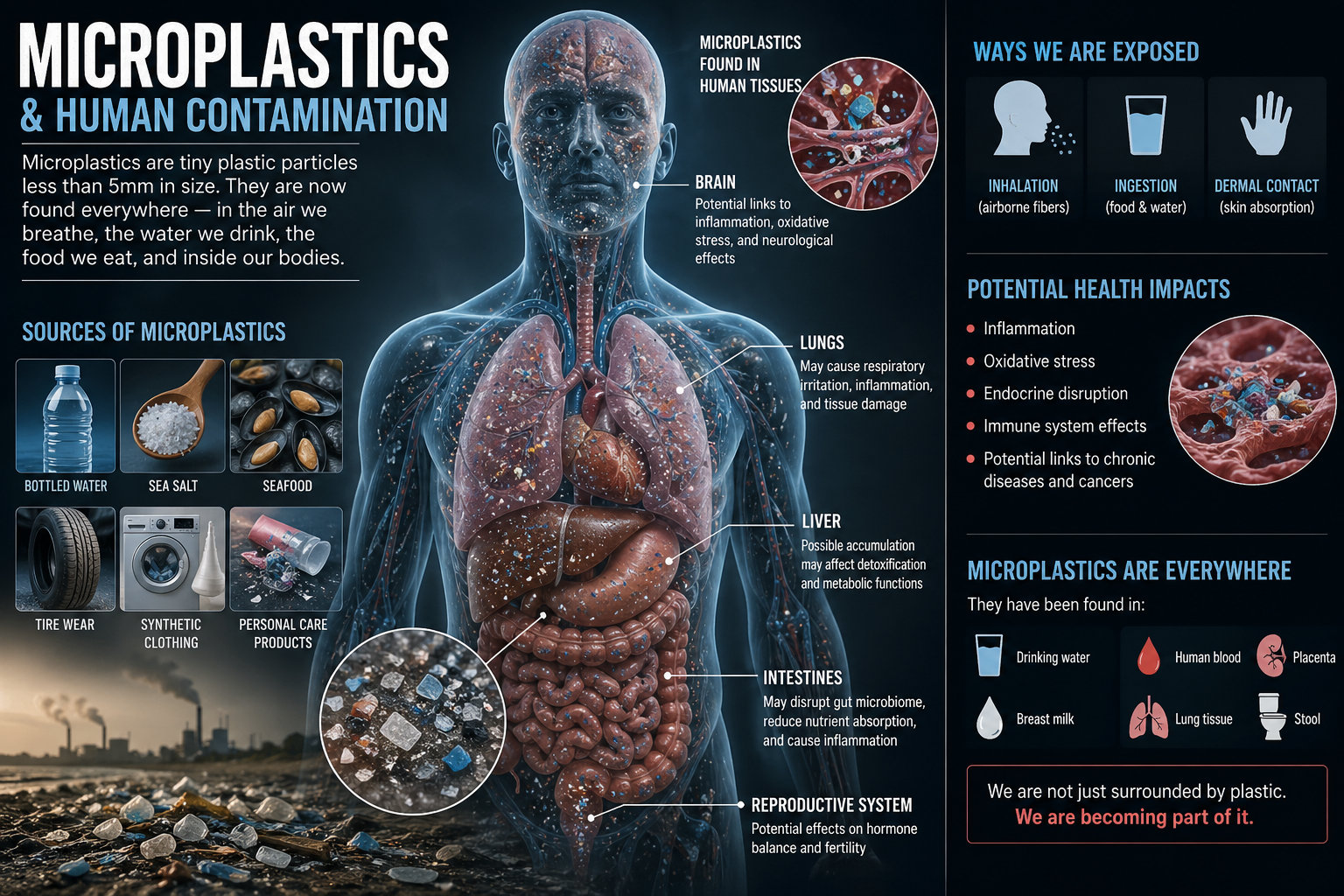
Microplastics, tiny plastic particles less than 5 millimeters in size, have quietly become one of the most pervasive contaminants on Earth, and increasingly, within the human body itself. Once thought to be primarily an environmental issue, research over the past decade has revealed that these particles are entering our bodies through the air we breathe, the food we eat, and the water we drink. Scientists now consider microplastics a growing public health concern, not because all their effects are fully understood, but because their presence is so widespread and persistent.
Recent studies have confirmed that microplastics are not just passing through the human body they are accumulating in it. Researchers have detected these particles in blood, lungs, placenta, breast milk, and even reproductive fluids, indicating systemic exposure across multiple biological systems. Their presence in such diverse tissues suggests that once microplastics enter the body, they can travel through the bloodstream and potentially lodge in organs. Experimental evidence also shows that microplastics can move from the digestive tract into organs like the liver, kidneys, and brain, raising new questions about long-term accumulation and toxicity.
The pathways of exposure are varied and constant. Humans ingest microplastics through contaminated food and water, inhale them from indoor and outdoor air, and may even absorb them through skin contact. Indoor environments, filled with synthetic materials and textiles, are now recognized as a major source of airborne microplastics. This means that everyday activities such as eating packaged food, drinking from plastic containers, or simply sitting in a furnished room can contribute to ongoing exposure.
The potential health impacts of microplastics are an active area of scientific investigation, and while definitive conclusions are still emerging, early findings are concerning. Microplastics can carry thousands of chemical additives, including substances known to disrupt hormones or cause cancer. Laboratory studies suggest that these particles may trigger inflammation, oxidative stress, and immune responses at the cellular level. There is also growing interest in how microplastics interact with the human microbiome, which plays a crucial role in digestion, immunity, and overall health.
Despite these concerns, significant scientific uncertainty remains. Researchers are still working to determine how much microplastic exposure is harmful, which particle sizes pose the greatest risk, and how long these particles persist in the body. Differences in detection methods and contamination during sampling also make it difficult to compare results across studies. In other words, while we know microplastics are present in humans, the full scope of their health effects is not yet fully understood.
What is clear, however, is that microplastics represent a new kind of environmental exposure one that blurs the line between external pollution and internal biology. As plastic production continues to rise globally, so too will the presence of these particles in ecosystems and human bodies. Addressing this issue will likely require both systemic changes, such as reducing plastic production and improving waste management, and individual actions like minimizing single-use plastics and choosing alternative materials. The story of microplastics in humans is still being written, but it already highlights a powerful truth: the materials we create do not simply disappear they become part of us.
Sources
- Nature Medicine (2024). Microplastics are everywhere — we need to understand how they affect human health.
- Springer Nature (2025). Growing concerns over ingested microplastics in humans.
- Nature Microbiology (2025). Microplastic research must consider microbes.
- ScienceDirect (2025). Microplastics in the human body and environment.
- Science of the Total Environment (2024). Microplastics in the human body: A comprehensive review.
- Frontiers in Public Health (2025). Microplastics and human health: toxicological pathways.
- Science of the Total Environment (2026). Micro- and nanoplastics in human biological matrices.
- ScienceDaily / University of New Mexico (2024). Microplastics move from gut to organs.
